Florida Atlantic Students Rally Against Campus Police's Planned Partnership with ICE
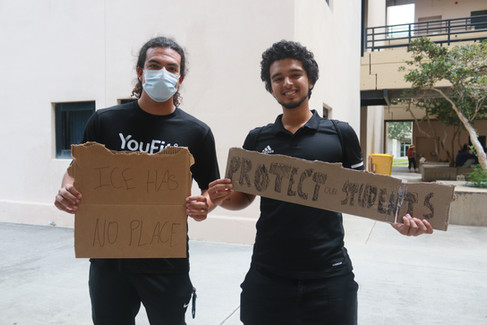
A controversial plan to cooperate with immigration police has sparked an outcry among students at FAU. Immigrant students as well as those with citizenship spoke out at the April 16 protest that went through the Breezeway and ended in front of the administration building.

All photographs by Laurie Mermet for MediaLab@FAU
By Laurie Mermet | MediaLab@FAU
Apr 16, 2025
Chanting “Hey hey, ho ho, immigration has got to go,” students at Florida Atlantic University marched Wednesday to protest a partnership between campus security and U.S. Immigration and Customs Enforcement (ICE).
The demonstration, organized by Solidarity, a socialist student group, came in response to reports that Florida Atlantic’s police department is pursuing a partnership with U.S. Immigration and Customs Enforcement (ICE) under the 287(g) program. If implemented, the agreement would make FAU the first university in the nation to allow its campus police to function as immigration enforcement officers.
“We take care of our own!” students declared. As they marched, they chanted: “ I-C-E, I-C-E. We don’t want your company.” Protesters held signs that read “FAU, you’re on thin ICE,” “No fascism at FAU” and the pointed comparison “ICE=Gestapo.” About two dozen students attended the protest.
At least 10 other universities in Florida have signed agreements with ICE. Joshua Glanzer, Florida Atlantic’s media relations spokesperson, said in a recent statement that FAU is following the guidelines of Gov. DeSantis’ Feb. 19 directive to Florida’s law enforcement agencies.
For Derek Caelen, a Florida Atlantic student who immigrated from Spain five years ago, the protest was deeply personal.
“As an immigrant, I had to come out to support. I don’t like that ICE is out here. This is supposed to be a safe space for education,” said Caelen, who has dual citizenship and comes from Spanish and Cuban heritage.
Florida Atlantic has touted its place as “the most ethnically and culturally diverse institution in Florida’s state university system.” With over 31,000 students across six campuses – including about 2,500 foreign students on visas – the university’s potential alignment with ICE has sent shockwaves through its multicultural student body.
Florida Atlantic student Andrew Zerrato, 31 and a first-generation immigrant from Colombia, was at the forefront of the march.
“I have a loud voice, I try to use it,” he said. “I myself come from a family of immigrants. Just being from a Latin community, I have a lot of family, friends, people that will get affected by ICE, whether they are citizens or not. Apparently they don’t care anymore.”
Frank Prieto, another student protester, shared his own immigration journey.
“I came from Mexico when I was 6. I’m a first generation immigrant, so I don’t think this is fair. I just got my papers like last year,” Prieto said. “I have family that are in Las Vegas right now waiting on court dates.”
The protest comes after reports that Florida Atlantic’s Police Department has submitted paperwork to join ICE’s 287(g) program, following Gov. Ron DeSantis’ February announcement that all 67 county sheriffs in Florida have agreed to cooperate with the agency.
According to ICE’s official website, “The 287(g) Program enhances the safety and security of our nation’s communities by allowing ICE Enforcement and Removal Operations (ERO) to partner with state and local law enforcement agencies to identify and remove criminal aliens who are amenable to removal from the U.S.”
A student who identified himself only as Teddy, citing safety concerns, described a situation that allegedly occurred in early April.
“Lots of police came in and were stopping students asking if they were citizens,” he said. “This makes me scared, as someone who looks like me [and as someone with] family with a history of immigration.” Though born in Miami, Teddy’s family is from the Philippines. His story of a raid on campus could not be independently verified.
“How do you focus on finals during this time?” he said. “I was sitting in class days after [they first announced the partnership] trying to focus, and I was too anxious.”
“It's a very dangerous, difficult time here,” Teddy said, explaining his request for anonymity.
Not all protestors had planned to participate. Mia Morello, a Florida Atlantic senior and social work major, spontaneously joined the march on her way to class.
“I just walked up and was like, ‘Can I join?’ she said. “I feel like it affects everyone personally. If you don’t care about other people in the same way that you care about yourself, what are we really doing?”
One of the lead organizers of the protest, who declined to give his full name, explained the broader concerns.
“Migrant students will come here on their student visas, and then they’ll say something that the current administration doesn’t like, and they’ll get their visa revoked and they’ll get deported, so we want to prevent that from happening at FAU,” he said. The student, who identified himself as a freshman anthropology major, indicated he isn’t an immigrant himself but feels strongly about this issue.
Zerrato connected this to a broader pattern of changes at Florida Atlantic, including the closure of the Center for Inclusion, Diversity Education and Advocacy (IDEAs) last year after DeSantis signed Senate Bill 266, which restricted diversity, equity, and inclusion (DEI) programs in the state university system.
“There’s so much exclusion going on slowly,” Zerrato said. “They’re [trying to] make FAU a pillar of what [they think] Florida needs to look like, and it feels like Boca is such a good spot [to do so]... It’s a rich area, it’s a predominantly Republican area.”
When Zerrato learned about Florida Atlantic’s potential partnership with ICE, he immediately planned to protest – even if alone.
“[Immigrant students] are not going to be able to concentrate in class. They’re not going to be able to respond and really participate and learn, because they’re just constantly looking over their shoulders,” Zerrato said. “I love this campus, it’s so beautiful, such a nice place to walk around, but it feels like they’re going to take all that away, because part of the beauty is diversity.”